• Home
  • Bio
  • Books
  • Articles
  • Advertising
  • Film & Video
  • Blog
  • Contact
Angie Klink - Author, Historian, Copywriter, Scriptwriter

American Writers Museum is Stellar!

May 14, 2017 By Angie Klink Leave a Comment

As a blogger for the new American Writers Museum, I was invited to a very special preview day.

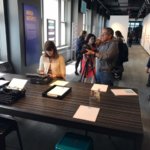
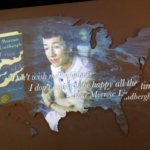
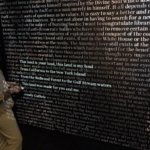
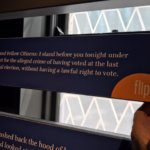
It was grand! The museum officially opens in Chicago on May 16, at 180 N. Michigan Avenue. The American Writers Museum (AWM) is the first and only museum in the United States dedicated to celebrating American writers and “exploring their influence on our history, our identity, our culture, and our daily lives.”

The museum is interactive and immersive.

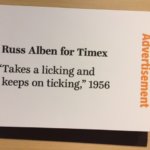
Visitors see what makes American literature different from all other world literatures, get to know authors, gain new perspectives on familiar authors and learn about writers of all genres from advertising copywriters like Russ Alben who wrote the famed Timex watch slogan, “It takes a licking and keeps on ticking,” to songwriters like Woody Guthrie. All forms of writing are honored.

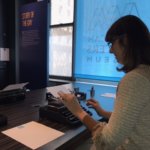
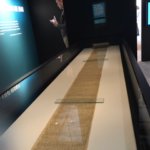
The Kerouac Scroll is a visiting exhibit and a fascinating must-see.

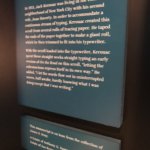
In 1951, Jack Kerouac wanted to write in a continuous stream on his typewriter (He would have loved a computer.), so he created a scroll from several rolls of tracing paper. He taped the ends of the paper together to make a giant roll, which he then trimmed to fit into his typewriter. With the scroll loaded into the typewriter, Kerouac spent three weeks straight typing an early version of On the Road, “letting the subconscious express itself in its own way.” He said, “I let the words flow out in uninterrupted waves, half awake, hardly knowing what I was doing except that I was writing.”

Malcolm O’Hagan is the passionate, driven founder of the AWM.

O’Hagan, born (the day before St. Patrick’s Day) and raised in Ireland, recognized that Ireland had a national museum dedicated to writers, but, alas, the United States did not. He set out to change that seven years ago, and today his vision has come to fruition.

This summer, consider taking a trip to Chicago and visiting the American Writers Museum. It’s a place for families, writers, readers, music lovers, advertising aficionados, and lovers of engaging, fun museums. The goal is to one day build a stand-alone museum.

There’s a quote from Flannery O’Connor printed on a bookmark at the AWM.

O’Connor said, “The writer operates at a peculiar crossroads where time and place and eternity somehow meet. His problem is to find that location.”

The American Writers Museum has found the perfect location—Chicago was chosen because it is the crossroad of our country. Time, place, and eternity have met there in a perfect salute to writers.


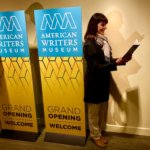
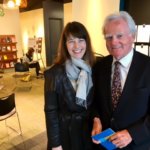
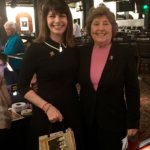
Author Angie Klink at Grand Opening of the American Writers Museum.

Help write a “story a day.”


Filed Under: Creative Endeavors, Writers Tagged With: American Writers Museum, Author Angie Klink, Authors, Chicago, Copywriters, Malcolm O'Hagan, Songwriters, Writers

Molly Murphy MacGregor, Godmother of National Women’s History Month

January 26, 2017 By Angie Klink Leave a Comment

All of our efforts are with the goal of making women’s lives visible, because invisibility is the number one form of bias.

                                                                       —Molly Murphy MacGregor, Co-Founder National Women’s History Project 


Molly Murphy MacGregor was a 26-year-old, California high school history teacher in 1972 when a male student asked her a question that would change the course of her life: “What is the Women’s Movement?”

MacGregor did not know the answer.

“As a young teacher, I couldn’t let the student know that I didn’t know the answer,” MacGregor said. “So I said, ‘What a good question. Let’s discuss it.’”

After school that pivotal day, MacGregor consulted her college history textbooks for an answer. “Only one chapter in one book contained information about the first Woman’s Rights Convention in Seneca Falls, New York, in 1848,” MacGregor said. “I had read it before—I received straight A’s in history—and yet somehow I had not remembered it. I had not even realized how much I owed those women. For me, that was the beginning.

It was the beginning of MacGregor’s realization that women’s narratives had been left out of history books, classrooms, and the media. Women were invisible because their stories had not been told. It was oppression by omission.

“What I didn’t know that day was that that moment of realization would set the course for my life’s work,” MacGregor said. “I asked new questions in all my classes. As we studied American history, I’d ask, “Did these events impact men and women differently? Did they impact cultural groups differently?’”

MacGregor’s “conversion moment,” spurred by one student’s question, was ultimately what sparked MacGregor’s co-founding of what are today two national icons: The National Women’s History Project (NWHP), a nonprofit educational resource and clearinghouse for multicultural women’s history, and National Women’s History Month held annually in March.

MacGregor’s journey to become the executive director of the NWHP and co-founder of National Women’s History Month began when she returned to college at Sonoma State in the mid seventies. “It was magic after that,” MacGregor said. “I became very involved in Women’s Studies and a women’s history slide show. We traveled all over, and each time we showed the presentation, we could see that people knew nothing about women’s history.”

MacGregor also taught classes at a community college where her students conducted a research project counting how many books about women were available in their local elementary school libraries. There were only three to seven biographies about women in each library. “The real problem was that the books had not been checked out in five to fifteen years,” said MacGregor. “As a teacher, I knew why that hadn’t been checked out—it was because the books had not been assigned.”

MacGregor was also a volunteer on the Sonoma County, California Commission on the Status of Women. She spearheaded the idea of a Women’s History Week for county schools. Curriculum guides were created and a celebratory parade was organized. “We provided resources, and the teachers could really teach it,” MacGregor said. “It was a way to introduce teachers to information they didn’t have.

The first ever Women’s History Week held in California in 1978 included March 8, International Women’s Day. Organizers focused on women as professionals. “We wanted girls to take math and science,” MacGregor said. “They didn’t understand how much they needed math and science to be admitted to a university.”

Professional women were recruited to visit schools. Teachers set the scene saying, for example, “Tomorrow we’re going to have a visit from a dentist.” The next day, a woman would enter the classroom, and the students would be taken aback—the dentist was not a man.

The first Women’s History Week was a success, and MacGregor was hired as projects director for the Sonoma County Commission on the Status of Women. In 1979, with the impetus to promote a National Women’s History Week, MacGregor attended an invitation-only, 19-day Women’s History Institute for Women Leaders held at Sara Lawrence College in Bronxville, New York. Dr. Gerda Lerner was chair of the institute. Lerner is credited as the single most influential figure in the development of women’s and gender history since the 1960s.

“When I received the invitation I was speechless, overwhelmed, and completely intimidated,” MacGregor said. Conference attendees included acclaimed women who were presidents of national organizations such as the Girl Scouts of the USA, National Organization for Women (NOW) and the American Association of University Women (AAUW).

“I was one of the youngest people there, and I was not an academic,” MacGregor said. Again, MacGregor’s mission to promote women’s history took a giant leap forward.

MacGregor presented her idea of a National Women’s History Week, and the Women’s Institute passed a resolution calling for its establishment. The participants immediately began using their organizational skills and political connections. Women around the country petitioned their governors to declare the week of March 8 as Women’s History Week. Barbara Omalade wrote an article about the Institute for Ms. Magazine and included MacGregor as a contact for materials to promote the week. The grassroots movement spread. MacGregor received hundreds of requests. Then she received a call from the White House.

MacGregor remembered answering the phone: “A woman said, ‘I’m Sarah Weddington, the special assistant to President Carter. He wanted me to call you and let you know that he’s going to issue a special message to the American people about Women’s History Week.’”

MacGregor was astounded.

President Jimmy Carter issued a Proclamation calling on the American people to pause and remember the tremendous contributions of American women and declared March 2-8, 1980 as National Women’s History Week. The next year, Sen. Orrin Hatch and then-Rep. Barbara Mikulski co-sponsored a congressional resolution proclaiming Women’s History Week.

Also in 1980, MacGregor and four others formed the nonprofit National Women’s History Project in Santa Rosa, California, offering resources and knowledge to lift the stories of women’s contributions out of the shadows. Today, the NWHP is known nationally as the only clearinghouse to provide information and training in multicultural women’s history for educators, organizations, parents, and others.

In 1987, the NWHP successfully lobbied Congress to declare the entire month of March as National Women’s History Month. National Women’s History Month celebrates it’s 30th anniversary in 2017, and the NWHP has planned their theme— “Trailblazing Women in Labor and Business.”

“Every year we select a theme, and then we accept nominations of women whose lives exemplify that theme,” MacGregor said. “We offer educational and celebratory items, such as our Women’s History Gazette, and a press packet to make it easy for organizations and communities around the country to celebrate the theme.”

Lilly Ledbetter, Equal Pay Activist, and Barbara Hackman Franklin, former Secretary of Commerce, are among this year’s thirteen honorees. Open to all, an honoree luncheon will be held in Washington D.C. on March 25 with tickets available on the NWHP website.

After Hillary Clinton’s historic presidential campaign, the NWHP created one of their most ambitious publications to date—First Woman—a 48-page commemorative volume that pays tribute to Clinton and to the many women who were “first” to hold elected positions in the United States. “We published First Woman to highlight the extraordinary journey for women to participate in our government, from winning the right to vote to being an elected official,” said MacGregor. “First Woman lays out the challenges women face, yet, highlights how we’re moving forward through the next generation of women who have new skill sets and connect through social media.”

First Woman is available as an e-book for $4.95 at www.nwhp.org. It will be available in print in early 2017.

From the day 45-years ago when she searched her college history books to find information about the Women’s Movement, to 2016 when she led the NWHP to publish First Woman, MacGregor, 70, continues her quest to render women’s contributions visible.

“Women’s history transformed me,” said MacGregor. “It gave me a sense of confidence and made me feel connected to everyone. I believe it can transform others. If women know how strong, brave and bold other women have been, they can feel that way, too. And if men know how strong, brave and bold women have been, they will feel more respect for women.”


This article originally ran on the Ms. Magazine Blog on December 27, 2016.


The National Women’s History Project (NWHP) invites you to become a member. Memberships are just $35 and give access to the latest happenings in multicultural women’s history. The NWHP has established the Women’s History Alliance with the goal to advocate for Women’s Equality Day, August 26—the anniversary date of American women winning their right to vote—to be declared a federal holiday. Become a NWHP member and stay abreast of the latest to celebrate the 2020 centennial anniversary of women receiving their right to vote. http://www.nwhp.org/

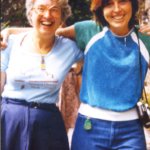
At Women’s Institute, 1979.

Author Angie Klink with Molly Murphy MacGregor, Co-Founder and Director of the National Women’s History Project (NWHP), 2016.

Filed Under: Creative Endeavors, National Women's History Project, The Deans' Bible Tagged With: 2020 Centennial Anniversary of the Vote, Author Angie Klink, First Woman, National Women's History Month, National Women's History Project, NWHP, Women's History, Women's Suffrage

Angie Klink - Author, Historian, Copywriter, Scriptwriter
  • Books
  • Articles
  • Film & Video
  • Advertising
  • Blog
  • Contact

Follow Angie

© 2026 Angie KlinkBack to top ↑

Copyright © 2026